We introduce "Monetary Policy Tech" – by analogy to SupTech and RegTech – to describe the rapidly growing use of AI and machine learning in central banking. The paper argues that AI affects central banks in two distinct ways: indirectly, through its impact on the macro-financial environment (productivity, market concentration, volatility, labour disruptions, inequality), and directly, through its impact on how central banks themselves do their work.
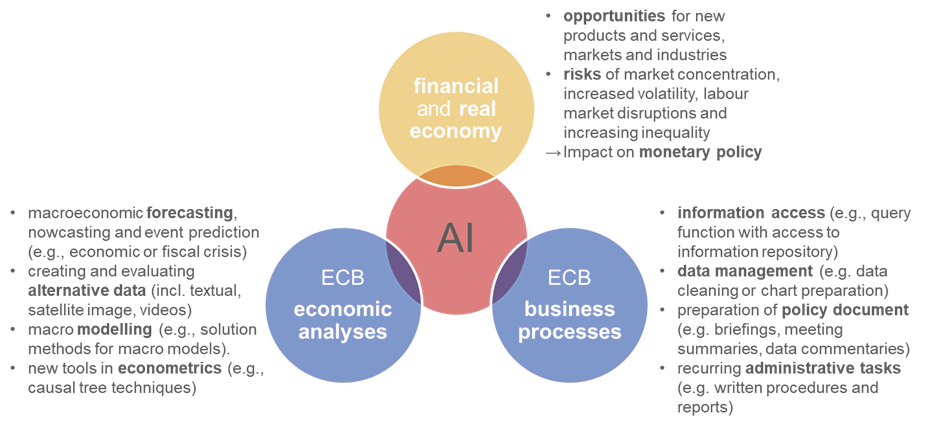
We organise the direct impact along two axes. On the analysis side, we review how AI is transforming nowcasting (with alternative data such as satellite imagery, text and microdata), forecasting (where machine-learning models have beaten traditional benchmarks for inflation), macroeconomic modelling (deep learning to solve large DSGE/HANK models), and central bank communication (embeddings, sentiment analysis, even facial expressions of central bankers). On the business-process side, we cover document retrieval (chatbots and retrieval-augmented generation), data management (auto-cleaning, anomaly detection, web scraping) and document preparation (briefing tools, summarisation, consistency checks).
Throughout, one message remains core: humans stay the ultimate decisionmakers. The stochastic nature of AI outputs and the trade-offs between efficiency and confidentiality mean that governance and human oversight matter more, not less, as AI adoption deepens.
Key takeaways
- AI hits central banks in two ways – through the economy they monitor, and through the work they do.
- Machine learning now beats traditional benchmarks for inflation forecasting; alternative data (satellite, text, microdata) unlock new nowcasting signals.
- Generative AI is moving from analysis into operations – document retrieval, briefing drafts, data commentary.
- Governance, validation and human oversight are the binding constraints, not technology.
- Three open questions: Does AI actually improve forecast accuracy? How do we validate AI for policy-grade work? Will AI agents on both sides of policy create new endogeneity loops?