We evaluate the causal effect of NextGenerationEU (NGEU) subsidies on solar energy deployment in Italy. By combining administrative disbursement data with a novel remote-sensing algorithm applied to Sentinel-2 satellite imagery, we detect and map more than 32,000 photovoltaic installations across the country – and link them directly to public spending.
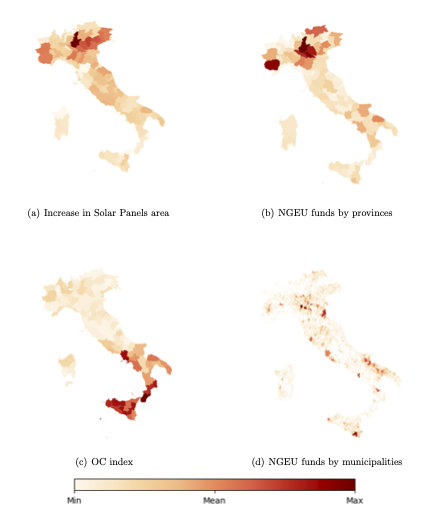
The headline finding is encouraging: on average, every €100 of NGEU spending generated about 2.5 m² of new solar panel area – in line with industry cost standards. But the national average hides a sharp divide. In northern and central Italy, funds translate into installations as intended. In southern regions with higher organized crime presence, the effect is essentially zero.
Our estimates suggest that around €370 million in EU subsidies dedicated to solar panels may have been diverted or misused in regions with weak governance. Institutional quality – not the design of the scheme – emerges as the binding constraint on green transition policy.
Key takeaways
- NGEU subsidies work – where institutional capacity holds. Every €100 buys about 2.5 m² of new solar panels on average.
- The effect collapses in regions with high organized crime presence, even though headline disbursement looks the same.
- Around €370 million of EU green subsidies in Italy may have been diverted or misused.
- Satellite imagery provides a free, scalable, fraud-resistant tool to monitor decentralised public investment.
- Implication for policy design: green transition spending needs to be paired with strong, granular institutional oversight – not just absorption metrics.
Forthcoming as an ECB Working Paper.